




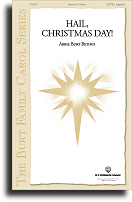

Hail, Christmas Day!
Voicing: SATB a cappella or SSAA a cappellaText: John H. Burt, from a poem he sent out as his Christmas Card in 1953
Duration: 2 min.
Premiere: SATB: The MPR Carolers, Minnesota Public Radio - Dec. 2003
SSAA: Pike Kor, Luther College - Nov. 2007
Published by: Fred Bock Publications (SATB Chorus)
Abbie Betinis Music Co. (SSAA Chorus)
LISTEN:
MPR Carolers (mp3): 1:39, 1.5 MB (SATB)
PROGRAM NOTE:
 I have been spending my Christmases in Marquette, Michigan since 1984, the year my grandparents, John and Martha Burt, decided to make the shores of Lake Superior their year-round home. At Christmas Eve we sing carols around the crèche, each one taking turns choosing a carol. Last year my grandmother requested my carol, "In a Far Judean City," and it was exciting for me to fully become part of that longstanding Burt tradition of Christmas Eve.
Another family tradition of singing rounds, or canons, was a major influence on this year's carol, "Hail, Christmas Day!" which features a round in its final verse. My family loves to sing rounds around the campfire, during long car trips, while hiking, etc. I've enjoyed "holding my own harmony" ever since I can remember, always fascinated by the prospect of one melody cycling around to create so many rich harmonies.
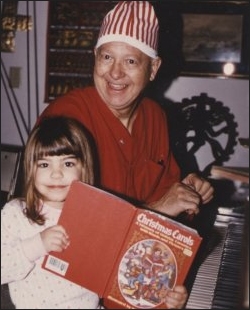
Grandpa (Rev. John H. Burt, the author of this poem) has always been my biggest fan and especially encouraged me to study music. He is a fine pianist and we all love to sing and play instruments while he plays jazz and Broadway standards on the piano at every visit.
I've tried to make this year's carol, "Hail, Christmas Day!" historically accurate, yet immediately accessible. Grandpa's text is written in a medieval style prominent especially in the 14th-16th century, when Latin phrases were often used to close each verse (the well-known carol In Dulci Jubilo is an example). I wanted my music to reflect the dance rhythms of the medieval ages, so I used an alternating meter, with accents that shift and surprise the listener. I also wanted to involve the strong tradition of round-singing, which was coming into its own in the years leading up to the 16th century. In the final verse of my carol, each voice begins in sequence, until there are three wholly different lines occurring at once, joyfully cycling around.
I hope listeners find this carol to be a joyous celebration of the news of Christ’s birth, just as so many before us have anticipated the joy of Christmas.
More information on the Burt Family Carols here.
- Abbie Betinis, 2003
Hail, Christmas Day that brings the story
Echoed forth from East to West
Unto us God comes in glory,
Hodie, Iesu Natus Est!
Over Bethlehem hills a-singing,
Down through centuries to our day:
Peace, good will, and love he's bringing,
Gloria Tibi, Domine.
What does this birth to us betoken?
Can he save from fear and doom?
This have saints and prophets spoken,
Christus Redemptor Omnium.
So, good people, let's be giving
Praise and offerings profuse
Unto Christ, the Lord of Living,
Adeste Fidelis, gaudeamus.
"A Carol in the tradition of the 15th century" © 1953 by John Harris Burt. Reprinted by permission of the author.
Performed by :
Anima Young Singers of Greater Chicago (Emily Ellsworth, conductor), Illinois
Chorus pro Musica (Betsy Burleigh, conductor), Massachusetts
Canadian Mennonite University Women's Chorus (Janet Brenneman, conductor), Manitoba, CANADA
Kent State University Chorus (Scott MacPherson, conductor), Ohio
MACxima (Keith Brown, conductor), Ohio
Master Singers of Milwaukee (Eric Townell, conductor), Wisconsin
Madrigal Choir of Binghamton (Anne Boyer Cotten, conductor), New York
MPR Carolers, Minnesota
Northwest Repertory Singers (Paul W. Schultz, conductor), Washington
Philadelphia Singers (David Hayes, conductor), Pennsylvania
Phipps Center for the Arts Festival Chorus (Thomas Dahle, conductor), Wisconsin
Piedmont Chamber Singers (William Osborne, conductor), North Carolina
Pike Kor, Luther College (Sandra Peter, conductor), Iowa
Renaissance Voices (Harold Stover, conductor)
Rochester Oratorio Society (Eric Townell, conductor), New York
St. Catherine's Womens Choir (Patricia Connors, conductor), Minnesota
St. Paul's on-the-Hill Choir (Patrick McDonough, conductor), Minnesota
San Antonio Chamber Choir (Scott MacPherson, conductor), Texas
The Singers--Minnesota Choral Artists (Matthew Culloton, conductor), Minnesota
Una Vocis Choral Ensemble (Dennis Lee, conductor), Iowa
UWSP Women's Choir (Judy Bond, conductor), Wisconsin
Valley Chamber Chorale (Carol Carver, director), Minnesota
Voces Novae et Antiquae (Robert Ross, conductor), Pennsylvania