





- or -
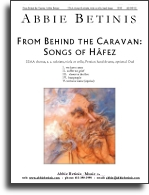
Look inside!
From Behind the Caravan: Songs of Hâfez
* named a "Top 25 Contemporary Choral Gem" by Kevin Meidl/Phillip Swan
* mvt II: chosen for Texas All-State 2015
I. We Have Come II. Suffer No Grief
III. Closer to the Fire
IV. Boatpeople
V. We Have Come (reprise)
Forces: SA soloists, SSAA chorus, viola or cello, hand drums, optional Oud
Text: Hâfez-e Shirazi (14th century Sufi mystic)
Language: Medieval Persian (Farsi)
Duration: 13 min.
Commissioned & Premiered by: The Rose Ensemble, 2007
Published by: Abbie Betinis Music Co.
Catalog No.: AB-049-02 (full suite); AB-049-11 (mvts 1 & 5 only); AB-049-22 (mvt 2 only); AB-049-P2 (string part)
See the score: PREVIEW THE SCORE (pdf)
 REVIEWS (click to view/hide)
"...new and fascinating. . . Both Betinis and Whitacres song cycles were written at the age of 26, and given their originality and appeal, both composers are ones whose many more works should be anticipated eagerly."
- Philippa Kiraly, The Gathering Note (Seattle, WA), April 2008
"Soloists Ashley Klassen and Cassandra Chugh were heart-stopping in Abbie Betinis' arresting From Behind the Caravan: Songs of Hâfez, inspired by 14th-century Persian poetry."
- Gwenda Nemerofsky, Winnipeg Free Press (Winnipeg, MB), Feb 2009 [see all]
"Elektra [Women's Choir] has taken many adventurous turns in their music over the past quarter century, and the centrepiece in this concert is no exception its an exotic, thrilling and evocative work by Abbie Betinis called From Behind the Caravan: Songs of Hâfez."
- Jeff Reilly, CBCmusic, Mar 1, 2013 [see all]
- Philippa Kiraly, The Gathering Note (Seattle, WA), April 2008
"Soloists Ashley Klassen and Cassandra Chugh were heart-stopping in Abbie Betinis' arresting From Behind the Caravan: Songs of Hâfez, inspired by 14th-century Persian poetry."
- Gwenda Nemerofsky, Winnipeg Free Press (Winnipeg, MB), Feb 2009 [see all]
"Elektra [Women's Choir] has taken many adventurous turns in their music over the past quarter century, and the centrepiece in this concert is no exception its an exotic, thrilling and evocative work by Abbie Betinis called From Behind the Caravan: Songs of Hâfez."
- Jeff Reilly, CBCmusic, Mar 1, 2013 [see all]
LISTEN (click to view/hide)San Francisco Girls Chorus live at Cerritos Performance Center, Cerritos, California. Nov 1, 2009
Tracks 1-5: THE ROSE ENSEMBLE (recorded live)
Jordan Sramek, artistic director; Ginna Watson, vielle; Tim O'Brien, percussion; David Burke, oud
Tracks 6-11: SEATTLE CHORAL COMPANY (recorded live)
Freddie Coleman, conductor; Stephen Creswell, viola; Jane Hall, riq/tabla; Stephen Elaimy, oud; Behrooz Alavi, ney
PROGRAM NOTE
 Johann Wolfgang Goethe once wrote, "Only with you, Hafez, do I wish to compete, for the older you get the younger you become. . . And religion is no obstacle, for if the word 'Islam' means to submit to God, we all live and die in Islam."
Khwâja Hâfez-e Shirazi was a 14th century mystic poet from Shiraz, Persia (Iran). He wrote over 400 lyric poems, called ghazals, and his mastery of that form remains celebrated today. His writing is based on Sufism, a mystical tradition of Islam which focuses on the personal journey of becoming nearer the Beloved through love, beauty, and ridding one’s heart of material desires. Sufism is associated with many currents of Islam, including both the Sunni and Shi’a sects, and has been practiced since the ninth century, and perhaps much earlier. Rumi (13th c.) is another well-known Sufi mystic poet.
I was particularly drawn to these four poems because of the elegant way they depict longing... longing for Truth, longing for Reason, longing for Kindness, Love, and – always – longing for the Beloved. I also found that many of Hâfez’s poems seem to have in common beautiful metaphors of transience: fire, breath, breeze.
In fact, I was fascinated to learn that the symbols of fire and breath are connected. In the first (and fifth) text, Hâfez addresses himself, asking himself to throw off his "kherqe" (his woolen shawl), which is a symbol of outward piety, and to show his true faith by breathing out his despair with the sigh "Ah!" It is said that the "Ah!" is a sign of sincerity, and can burn a hypocrite with the genuine fire of the soul.
In setting these historic and culturally-iconic texts, I have desperately tried to remain true to the intonation of the language, and to Hâfez’s poetic instinct. Each poem unfortunately had to be shortened to create a concert piece, but I encourage singers to seek out the original poems to read in their entirety, or to seek out recordings of the spoken text. I owe special thanks to Behrooz Alavi for sharing with me his insights into Hâfez’s poetry, pronunciation, and rich performance practice.
The music is not at all meant to be authentically Persian, but is my own interpretation of an assortment of influences, including my recent love of Persian poetic meter and form, Middle Eastern musical systems and modes, and perhaps even distant memories of dancing barefoot with my Greek relatives, joyfully and tirelessly, to music that whirled feverishly around us, and – at four years old, with my arms held up to clutch their hands on either side – feeling completely free.
The suite is dedicated with great admiration to The Rose Ensemble, who commissioned it, and who premiered it with their characteristic precision and panache on their Candlelight Concert: Mystics, Prophets, Sages & Seers in the spring of 2007.
- Abbie Betinis
PERFORMANCE NOTES (click to view/hide)
Language: Amazingly, the Persian (Farsi) language has remained largely unchanged for a thousand years, and Hâfez’s poetic tradition remains strong, particularly in Iran. If possible, query your local Irani community for a native speaker to coach your singers on these beautiful texts. A transliteration guide is included in the score.
Instrumentation: The instrumentation of this suite can be easily modified. The conductor may choose viola or cello as the primary accompanying instrument, with the option of doubling oud on mvts I, III & V, or improvised Persian ney flute. Transposed parts for soprano sax (mvts I, III, V only) are available from the composer upon request. Recommended percussion is below. Percussionist should improvise where indicated.
Hand percussion recommended:
Mvt. I & V = Riq or tambourine
Mvt. II = Tombak. Daf, or other frame drum, is also possible.
Mvt. III = Tombak, handclaps, or other high-pitched, sharp percussive sounds.
Mvt. IV = none
Programming: Each of the poems has a traditional way of being sung, so, if you wish, it is possible to introduce each movement with a bit of the music in the traditional manner. Improvised interludes performed in the Persian style between some or all movements, whether instrumental or sung, in whole or in part, have proven to be a rich addition to the concert suite.
Resources: Pronunciation recordings, downloadable instrumental parts, recordings of various instrumentations, and articles on Sufi tradition and context are all included by the publisher in full orders (score & parts) of this piece and require a login and password. If you did not receive a unique login at purchase, please contact Abbie.
Instrumentation: The instrumentation of this suite can be easily modified. The conductor may choose viola or cello as the primary accompanying instrument, with the option of doubling oud on mvts I, III & V, or improvised Persian ney flute. Transposed parts for soprano sax (mvts I, III, V only) are available from the composer upon request. Recommended percussion is below. Percussionist should improvise where indicated.
Hand percussion recommended:
Mvt. I & V = Riq or tambourine
Mvt. II = Tombak. Daf, or other frame drum, is also possible.
Mvt. III = Tombak, handclaps, or other high-pitched, sharp percussive sounds.
Mvt. IV = none
Programming: Each of the poems has a traditional way of being sung, so, if you wish, it is possible to introduce each movement with a bit of the music in the traditional manner. Improvised interludes performed in the Persian style between some or all movements, whether instrumental or sung, in whole or in part, have proven to be a rich addition to the concert suite.
Resources: Pronunciation recordings, downloadable instrumental parts, recordings of various instrumentations, and articles on Sufi tradition and context are all included by the publisher in full orders (score & parts) of this piece and require a login and password. If you did not receive a unique login at purchase, please contact Abbie.
TEXT & TRANSLATIONS (click to view/hide)
I. we have come
(Hear the entire text in Persian: example)
We, to this door, not seeking pride or glory... we have come.
For shelter from ill-fortune, here... we have come.
Traveling along love's journey, from the borders of nothingness,
Now into states of being, all this way... we have come.
O ship of grace, where is thy anchor of forbearance?
For in this ocean of generosity, immersed in sin... we have come.
Hâfez, throw off your woolen kherqe [Sufi cloak], for we,
from behind the caravan, with the fire of sighing "ah!"... we have come.
II. suffer no grief
(Hear the entire text in Persian: example 1, example 2)
Forsaken Joseph to Canaan shall return.
Suffer no grief.
Upon the thorny stalks of family grief, a rose shall bloom.
Suffer no grief...
If you desire the Way and plant your pilgrim foot in the desert,
Then if the mighty Arabian thorn make reproofs,
Suffer no grief...
Suffer no grief, suffer no grief, O heart.
Back to reason, comes this distraught head.
Suffer no grief...
O heart, despairing heart,
O! O! Suffer no grief...
There is no road that has no end.
III. closer to the fire
(Hear the entire text in Persian: example 1, example 2)
Last night I saw the angels beat at the door of the tavern,
The clay of Adam, they shaped and into the mould, they cast.
The churches war among themselves, forgive them;
When they could not see the truth, they beat the door of fable.
Fire, Fire! Oh! Oh!
Thanks be to God, for between me and Him, peace chanced,
The dancing Sufis cast the cup of thankfulness!
Fire, Fire! Oh! Oh!
IV. boatpeople
(Hear the entire text in Persian: example)
My heart falls from grasp. For God's sake come to my cry, O pious ones;
O the pain that Love's hidden mystery should be disclosed!
Arise, arise O breeze
To ease the pain of the world, live by these words:
With friends, give kindness; with enemies, courtesy.
We are the shipwrecked. O fair breeze, arise!
So that, again, we may behold the face of the Beloved.
Behold !
V. we have come (reprise)
(Hear the entire text in Persian: example)
We, to this door, not seeking pride or glory... we have come.
For shelter from ill-fortune, here... we have come.
sighing "ah!"...
We have come.
(Hear the entire text in Persian: example)
We, to this door, not seeking pride or glory... we have come.
For shelter from ill-fortune, here... we have come.
Traveling along love's journey, from the borders of nothingness,
Now into states of being, all this way... we have come.
O ship of grace, where is thy anchor of forbearance?
For in this ocean of generosity, immersed in sin... we have come.
Hâfez, throw off your woolen kherqe [Sufi cloak], for we,
from behind the caravan, with the fire of sighing "ah!"... we have come.
II. suffer no grief
(Hear the entire text in Persian: example 1, example 2)
Forsaken Joseph to Canaan shall return.
Suffer no grief.
Upon the thorny stalks of family grief, a rose shall bloom.
Suffer no grief...
If you desire the Way and plant your pilgrim foot in the desert,
Then if the mighty Arabian thorn make reproofs,
Suffer no grief...
Suffer no grief, suffer no grief, O heart.
Back to reason, comes this distraught head.
Suffer no grief...
O heart, despairing heart,
O! O! Suffer no grief...
There is no road that has no end.
III. closer to the fire
(Hear the entire text in Persian: example 1, example 2)
Last night I saw the angels beat at the door of the tavern,
The clay of Adam, they shaped and into the mould, they cast.
The churches war among themselves, forgive them;
When they could not see the truth, they beat the door of fable.
Fire, Fire! Oh! Oh!
Thanks be to God, for between me and Him, peace chanced,
The dancing Sufis cast the cup of thankfulness!
Fire, Fire! Oh! Oh!
IV. boatpeople
(Hear the entire text in Persian: example)
My heart falls from grasp. For God's sake come to my cry, O pious ones;
O the pain that Love's hidden mystery should be disclosed!
Arise, arise O breeze
To ease the pain of the world, live by these words:
With friends, give kindness; with enemies, courtesy.
We are the shipwrecked. O fair breeze, arise!
So that, again, we may behold the face of the Beloved.
Behold !
V. we have come (reprise)
(Hear the entire text in Persian: example)
We, to this door, not seeking pride or glory... we have come.
For shelter from ill-fortune, here... we have come.
sighing "ah!"...
We have come.
PERFORMANCES (selected)
2016 ACDA Southern Division HS Women's Honor Choir (Kathleen Rodde), Chattanooga, Tennessee - (Mvt II)
2015 National ACDA Conference, Salt Lake -- Santa Fe Desert Chorale (Joshua Habermann) - (Mvts I, II, V)
2015 Texas All-State Women's Choir (Kathleen Rodde), San Antonio, Texas - (Mvt II)
2011 Michigan High School Women's Honors Choir, Grand Rapids, Michigan - (Mvts I, II, V)
Cantala, Lawrence University (Phillip Swan), Appleton, Wisconsin
Cantamus Women's Choir, Iowa State University (Kathleen Rodde), Ames, Iowa
Chorus pro Musica (Jamie Kirsch), Cambridge, Massachusetts
Elektra Women's Choir (Morna Edmundson), Vancouver, BC, CANADA
Michigan State University Women's Chamber Ensemble (Sandra Snow), Lansing, Michigan
University of Manitoba Women's Choir (Elroy Friesen), Winnipeg, Manitoba, CANADA
Wellesley College Chamber Singers (Lisa Graham), Wellesley, Massachusetts - (Mvt II)
Women's Voices Chorus (Allan Friedman), Durham, North Carolina
...see more (click to view)
2015 National ACDA Conference, Salt Lake -- Santa Fe Desert Chorale (Joshua Habermann) - (Mvts I, II, V)
2015 Texas All-State Women's Choir (Kathleen Rodde), San Antonio, Texas - (Mvt II)
2011 Michigan High School Women's Honors Choir, Grand Rapids, Michigan - (Mvts I, II, V)
Cantala, Lawrence University (Phillip Swan), Appleton, Wisconsin
Cantamus Women's Choir, Iowa State University (Kathleen Rodde), Ames, Iowa
Chorus pro Musica (Jamie Kirsch), Cambridge, Massachusetts
Elektra Women's Choir (Morna Edmundson), Vancouver, BC, CANADA
Michigan State University Women's Chamber Ensemble (Sandra Snow), Lansing, Michigan
University of Manitoba Women's Choir (Elroy Friesen), Winnipeg, Manitoba, CANADA
Wellesley College Chamber Singers (Lisa Graham), Wellesley, Massachusetts - (Mvt II)
Women's Voices Chorus (Allan Friedman), Durham, North Carolina
...see more (click to view)
Allen High School Choir, Allen, Texas - (Mvt II)
Atlanta Young Singers (Paige Mathis), Atlanta, Georgia
Bella Voce Singers (Jessica Corbin), Brooklyn, New York
Belmont University Women's Choir (Lesley Mann), Nashville, Tennessee - (Mvt II)
Boston Conservatory Women's Chorus (Beth Willer), Boston, Massachusetts
Canyon High School Choir, New Braunfels, Texas - (Mvt II)
Cappella Clausura (Amelia LeClair), Boston, Massachusetts
Colorado Vocal Arts Ensemble (Deborah Jenkins Teske), Colorado Springs, Colorado
Ensemble Laude (Elizabeth MacIsaac), Victoria, BC, CANADA
Espressivo Singers, Whitby, Ontario, CANADA
Glenbard West High School Women's Ensemble (Andrew Jeffrey), Glen Ellyn, Illinois - (Mvt II)
Grafton High School Camerata, Grafton, Wisconsin
Illinois State University Concert Choir (women only) (Karyl Carlson), Normal, Illinois
Ithaca College Women's Chorale (Janet Galvan), Ithaca, New York
Knox College Choirs (Laura Lane), Galesburg, Illinois - (Mvt II)
Los Angeles Children's Chorus, Los Angeles, California
Louisiana State University Women's Chorale, Baton Rouge, Louisiana - (Mvt II)
Marblehead HS Treble Choir, Marblehead, Massachusetts
Metro State University of Denver Women's Chamber Choir (MB Kreuger), Denver, Colorado - (Mvts I, II, V)
North Jersey School Music Association HS Treble Choir, Secaucus, New Jersey - (Mvt II)
Ohio State University Women’s Glee Club (Kristina Caswell MacMullen), Columbus, Ohio - (Mvts I, II, V)
Pennsylvania Girlchoir with Lyric Fest (Mark Anderson), Philadelphia, Pennsylvania
Penthalia Singers (Alice Malach), Toronto, Ontario, CANADA
Pretoria High School for Girls Senior Choir, Pretoria, SOUTH AFRICA - (Mvt II)
Project Eve, Dallas, Texas
Resound Ensemble, San Francisco, California
Rudsambee Company of Singers, Edinburgh, Scotland, UNITED KINGDOM - (Mvt I)
Rutgers University Voorhees Choir, New Brunswick, New Jersey
San Francisco Girl's Chorus (Susan McMane), San Francisco, California
Seattle Choral Company (Fred Coleman), Seattle, Washington
Serenata Singers, Mission, BC, CANADA
Singing City (Jeffrey Brillhart), Bryn Mawr, Pennsylvania
Sound Circle (Sue Coffee), Boulder, Colorado
TAISM Festival Chorus, 2010 (Phillip Swan), Muscat, OMAN - (Mvt I)
Texas Tech Women's Chorale (Carolyn Cruse), Lubbock, Texas
The Rose Ensemble (Jordan Sramek), Saint Paul, Minnesota
Truman State University Women's Ensemble (Megan Petrie), Kirksville, Missouri
University of North Texas Women's Chorus (Peter Steenblik), Denton, Texas
University of Washington Chamber Singers (Geoffrey Boers), Seattle, Washington
Uppsala Chamber Choir (Francesco Acquista), Uppsala, SWEDEN - (Mvt I)
USC Thornton Oriana Choir (Lesley Leighton), Los Angeles, California
Voces Solis (Ryan Keeling), Pittsburgh, Pennsylvania - (Mvts I, II, V)
Vox Musica (Daniel Paulson), Sacramento, California
Women's World Music Choir, Goshen, Indiana
(Have you performed this piece? Add your performance!)
Atlanta Young Singers (Paige Mathis), Atlanta, Georgia
Bella Voce Singers (Jessica Corbin), Brooklyn, New York
Belmont University Women's Choir (Lesley Mann), Nashville, Tennessee - (Mvt II)
Boston Conservatory Women's Chorus (Beth Willer), Boston, Massachusetts
Canyon High School Choir, New Braunfels, Texas - (Mvt II)
Cappella Clausura (Amelia LeClair), Boston, Massachusetts
Colorado Vocal Arts Ensemble (Deborah Jenkins Teske), Colorado Springs, Colorado
Ensemble Laude (Elizabeth MacIsaac), Victoria, BC, CANADA
Espressivo Singers, Whitby, Ontario, CANADA
Glenbard West High School Women's Ensemble (Andrew Jeffrey), Glen Ellyn, Illinois - (Mvt II)
Grafton High School Camerata, Grafton, Wisconsin
Illinois State University Concert Choir (women only) (Karyl Carlson), Normal, Illinois
Ithaca College Women's Chorale (Janet Galvan), Ithaca, New York
Knox College Choirs (Laura Lane), Galesburg, Illinois - (Mvt II)
Los Angeles Children's Chorus, Los Angeles, California
Louisiana State University Women's Chorale, Baton Rouge, Louisiana - (Mvt II)
Marblehead HS Treble Choir, Marblehead, Massachusetts
Metro State University of Denver Women's Chamber Choir (MB Kreuger), Denver, Colorado - (Mvts I, II, V)
North Jersey School Music Association HS Treble Choir, Secaucus, New Jersey - (Mvt II)
Ohio State University Women’s Glee Club (Kristina Caswell MacMullen), Columbus, Ohio - (Mvts I, II, V)
Pennsylvania Girlchoir with Lyric Fest (Mark Anderson), Philadelphia, Pennsylvania
Penthalia Singers (Alice Malach), Toronto, Ontario, CANADA
Pretoria High School for Girls Senior Choir, Pretoria, SOUTH AFRICA - (Mvt II)
Project Eve, Dallas, Texas
Resound Ensemble, San Francisco, California
Rudsambee Company of Singers, Edinburgh, Scotland, UNITED KINGDOM - (Mvt I)
Rutgers University Voorhees Choir, New Brunswick, New Jersey
San Francisco Girl's Chorus (Susan McMane), San Francisco, California
Seattle Choral Company (Fred Coleman), Seattle, Washington
Serenata Singers, Mission, BC, CANADA
Singing City (Jeffrey Brillhart), Bryn Mawr, Pennsylvania
Sound Circle (Sue Coffee), Boulder, Colorado
TAISM Festival Chorus, 2010 (Phillip Swan), Muscat, OMAN - (Mvt I)
Texas Tech Women's Chorale (Carolyn Cruse), Lubbock, Texas
The Rose Ensemble (Jordan Sramek), Saint Paul, Minnesota
Truman State University Women's Ensemble (Megan Petrie), Kirksville, Missouri
University of North Texas Women's Chorus (Peter Steenblik), Denton, Texas
University of Washington Chamber Singers (Geoffrey Boers), Seattle, Washington
Uppsala Chamber Choir (Francesco Acquista), Uppsala, SWEDEN - (Mvt I)
USC Thornton Oriana Choir (Lesley Leighton), Los Angeles, California
Voces Solis (Ryan Keeling), Pittsburgh, Pennsylvania - (Mvts I, II, V)
Vox Musica (Daniel Paulson), Sacramento, California
Women's World Music Choir, Goshen, Indiana
(Have you performed this piece? Add your performance!)